Hey everyone! I have been meaning to post here for the past few days about my newest adventure but I just haven't had the time at all because I've been so busy out here in Pueblo, Colorado, working for the Obama campaign.
I arrived in Pueblo tuesday morning after a looong drive across California, Arizona, New Mexico and Colorado and was put right to work. In my first day "on the job" I canvassed door to door, phoned voters, painted signs for a rally and entered tons of data into the computer. My second day Joe Biden came to town, conveniently on a nearly freezing and windy day, for a rally so I spent all day on my feet running around organizing that and then all night recruiting volunteers from the data we collected on the attendees. The last few days I have become something of a "floater", helping out the staffers that need it around the office, mostly. Yesterday I helped out the out of state volunteer coordinator and today I've been with one of the field organizers (these are people who organize and are responsible for a specific area of "turf").
It's only been a few days but it feels like much longer, probably because all of my days start at 9 and go well past midnight and really couldn't be much fuller. I'm not sure what it is I do all day, but the time somehow goes by. I havent had a proper meal since my first day - mainly I just eat whatever donated food I can find in our back room. And (un)fortunately there is a bakery owned by huge Obama supporters right around the corner from our office so we have a lot of cookies around.
I can't even believe I found the time to write this. Thankfully my field organizer is extremely busy at the moment calling people (which is what I should have been doing), so I better go now... More soon, hopefully.
Friday, October 24, 2008


Monday, October 20, 2008
A New Adventure
Hello all! It's been a while since my last post, but if any of you were interested I wanted to keep you updated on my new adventure.
Monday morning (5:30, behind schedule, of course) I left the comforts of my warm bed and set off for Pueblo, a small town about 40 miles south of Colorado Springs - and a 17 hour drive, approximately. I followed I-15 until Barstow, where I turned east on I-40. By 9:30 I was crossing into Arizona. After a quick stop for coffee (which turned out to be almost undrinkable - who knew truckers liked their coffee so sickly sweet?) I was on my way again, up through the beautiful, and unexpected, forest around Flagstaff and right on through to Holbrook, a dusty highway town which just happened to be the halfway point of my journey. I was already tired, and more than a little numb, but prepared to press on after a Taco Bell lunch. I crossed into New Mexico at about 3 (well, 4 with the time change). This part of the drive took me through the painted desert, which was just a gorgeous sight. I tried to take some pictures, but I had to concentrate on not driving off the road.
I hit Albuquerque around sunset - and just in time for rush hour - at about 6, and then pushed on through towards Santa Fe as it was getting dark - just in time for the thunderstorm. I was getting low on gas by this point, but couldnt seem to find a gas station open (gas stations CLOSE at 7?! What do you mean?) and I was loathe to drive 4 miles off the freeway to try to find one. After the gas light went on I started to get a little worried, especially coupled with the imposing absolute black of nighttime in the middle of nowhere. I finally found gas, but by then I had had enough of driving, so I decided to stay the night in Las Vegas (woohoo). Las Vegas, New Mexico, that is!
After a refreshing night at the Super 8 Las Vegas I continued my drive towards Pueblo. I was grateful after just a few hours on the road that I hadn't wasted all that beautiful scenery by driving through at night. Out there in that country, it's easy to see where that romantic notion of "the west" comes from - morning mist rising from wide open valleys; the occasional spattering of farm houses surrounded by horses and cattle.
Anyway, I finally arrived in Pueblo close to 11 a.m. and came straight into the Obama Headquarters in downtown Pueblo. I was a little apprehensive when I saw all of the smokestacks as I was driving in on the freeway, and as I drove past the steel mill on the way in. I know that this is the reality in much of America, especially the politically important parts, but it's been so built up in my mind that I thought it was more myth than reality. But no, there is a steel mill. Once I got past the outskirts though, it turns out that Pueblo is really a very cute town with what looks like a lot of history and plenty of old-west buildings around. I'll try to take a few pictures once I get my camera battery charged.
My first assignment was to head over to the “staging location” in south Pueblo. This is a fancy name for their offices in south Pueblo, which is also kind of silly since it’s such a small town. So I drove the five blocks to the “staging location” and met up with Simon, who took me out to teach me how to canvas.
Canvassing. This is something I was NOT at all looking forward to. I’m not a particularly good or forceful salesman and I do not like disturbing people, especially if they might get upset with me disturbing their peace and quiet. Thankfully I missed the part of the campaign that was spent trying to convert McCain supporters or undecideds. Since early voting has already started here In Pueblo, our emphasis now is on encouraging the Obama supporters to actually vote. This means that most of the people I talked to are already “on my side” so more likely to be nice to me.
Or that’s the idea. The reality is that the vast majority of people either aren’t home or don’t answer the door when I knock. And of those who do, a good proportion just tell me that the person I am looking for doesn’t live there anymore. And occasionally the new occupant is a McCain supporter/anarchist/crazy person. But this is actually kind of rare. Mostly the canvassing was uneventful, but good exercise.
Monday morning (5:30, behind schedule, of course) I left the comforts of my warm bed and set off for Pueblo, a small town about 40 miles south of Colorado Springs - and a 17 hour drive, approximately. I followed I-15 until Barstow, where I turned east on I-40. By 9:30 I was crossing into Arizona. After a quick stop for coffee (which turned out to be almost undrinkable - who knew truckers liked their coffee so sickly sweet?) I was on my way again, up through the beautiful, and unexpected, forest around Flagstaff and right on through to Holbrook, a dusty highway town which just happened to be the halfway point of my journey. I was already tired, and more than a little numb, but prepared to press on after a Taco Bell lunch. I crossed into New Mexico at about 3 (well, 4 with the time change). This part of the drive took me through the painted desert, which was just a gorgeous sight. I tried to take some pictures, but I had to concentrate on not driving off the road.
I hit Albuquerque around sunset - and just in time for rush hour - at about 6, and then pushed on through towards Santa Fe as it was getting dark - just in time for the thunderstorm. I was getting low on gas by this point, but couldnt seem to find a gas station open (gas stations CLOSE at 7?! What do you mean?) and I was loathe to drive 4 miles off the freeway to try to find one. After the gas light went on I started to get a little worried, especially coupled with the imposing absolute black of nighttime in the middle of nowhere. I finally found gas, but by then I had had enough of driving, so I decided to stay the night in Las Vegas (woohoo). Las Vegas, New Mexico, that is!
After a refreshing night at the Super 8 Las Vegas I continued my drive towards Pueblo. I was grateful after just a few hours on the road that I hadn't wasted all that beautiful scenery by driving through at night. Out there in that country, it's easy to see where that romantic notion of "the west" comes from - morning mist rising from wide open valleys; the occasional spattering of farm houses surrounded by horses and cattle.
Anyway, I finally arrived in Pueblo close to 11 a.m. and came straight into the Obama Headquarters in downtown Pueblo. I was a little apprehensive when I saw all of the smokestacks as I was driving in on the freeway, and as I drove past the steel mill on the way in. I know that this is the reality in much of America, especially the politically important parts, but it's been so built up in my mind that I thought it was more myth than reality. But no, there is a steel mill. Once I got past the outskirts though, it turns out that Pueblo is really a very cute town with what looks like a lot of history and plenty of old-west buildings around. I'll try to take a few pictures once I get my camera battery charged.
My first assignment was to head over to the “staging location” in south Pueblo. This is a fancy name for their offices in south Pueblo, which is also kind of silly since it’s such a small town. So I drove the five blocks to the “staging location” and met up with Simon, who took me out to teach me how to canvas.
Canvassing. This is something I was NOT at all looking forward to. I’m not a particularly good or forceful salesman and I do not like disturbing people, especially if they might get upset with me disturbing their peace and quiet. Thankfully I missed the part of the campaign that was spent trying to convert McCain supporters or undecideds. Since early voting has already started here In Pueblo, our emphasis now is on encouraging the Obama supporters to actually vote. This means that most of the people I talked to are already “on my side” so more likely to be nice to me.
Or that’s the idea. The reality is that the vast majority of people either aren’t home or don’t answer the door when I knock. And of those who do, a good proportion just tell me that the person I am looking for doesn’t live there anymore. And occasionally the new occupant is a McCain supporter/anarchist/crazy person. But this is actually kind of rare. Mostly the canvassing was uneventful, but good exercise.
Thursday, July 10, 2008
Casa, Sweet Casa
I've been meaning to post some photos of where I live ever since I arrived, but I was always waiting for a really great time right after I spent a whole afternoon cleaning. But who am I kidding? When I do clean, I like to do bits by bits, meaning that the whole place is never clean at the same time. Add to that roommates who don't clean up for themselves/still haven't fully moved in (I was so spoiled by living alone...) and, well, it just isn't going to happen. So, here you go, a real life peek at the way It Really Is.
 Here's a map to get an idea of where I live, although it probably wouldn't mean anything to you unless you know about the city. Basically I live 3 miles or so from the center. From an American perspective, I realize that that is not at all far. I practically have to drive that far to get to the nearest grocery store at home. But Madrid is really a pretty small city and being European, pretty compact. The "center" is probably only about 1 square mile. Maybe 2. And when you have to walk everywhere... I wouldn't say I live in a suburb, exactly. But I might go so far as "outskirts". It's kind of like... the center is Manhattan, and I live in Brooklyn. Which is certainly more "authentic". This is where the real Madrileños live. But getting to the action requires a taxi, the metro or a very long walk. It is a very nice, very safe neighborhood, though. Not even any crackheads or anything.
Here's a view of my front door.

Did I mention I live in a garage? That might sound like the terrible, though inevitable, fate of a college grad with no real income to speak of. And, in some ways, you would be right. But no worries, I'm not camped out in some abandoned building, keeping warm by lighting fires in garbage cans, carting around my meager possessions in an abandoned shopping cart. Not yet anyway.

This is what the door looks like after I use my garage door opener to get in the house. We having amazing stealth capabilities here. It can be fun to startle people by opening the door while they're loitering by it. It also has the added benefit of not having any stairs to climb, although that can't be good for my girlish figure.

This is the view from the front door. The apartment is actually quite large. The tradeoff for extra space is that we have only one window, in the kitchen, which opens out into a light well. We do not get a whole lot of natural light. If I leave the roll up door open we do have some opaque windows facing the street that give the illusion of daylight. Most leased apartments in Spain come furnished, or at least most of the ones I have seen, so most of what you can see comes with the place. Thankfully my landlady doesn't have terrible taste. She also fancies herself as something of an artist, so we have a rather eclectic assortment of her originals adorning the walls.

Here's the kitchen - where all the magic happens. When I got here I was impressed by it's classiness. "Oooo, stainless steel, how swank," thought I. How naive. As I have come to discover, stainless steal is an idiotic thing to make your kitchen out of unless you never actually USE your kitchen. Or if you're a professional chef and you have people who you pay special to come in and clean up for you after you've had your fun. But, seeing as I do (and I don't), the novelty of being able to watch myself cook quickly gave way to the reality of the stuff being impossible to keep clean. Add to that the fact that you have to use special cleaner or you'll scratch it (groan) and it's hard to muster up the energy to even bother. And it's not just food. Heaven forbid you actually touch one of the drawers to open it. Fingerprint city! No, this is a not a kitchen for the obsessive compulsive cleaner. Or maybe it's the perfect one... Regardless, it is a nice kitchen and serves it's purpose well.
Here is the yard:

Hahaha. No, really. And the lovely view as well. The one in the middle is the basil plant that I haven't completely killed yet. I attempted to grow more herbs, but unfortunately the lack of natural light was not kind to their tender seedling selves.
Here's a view of the dining room/living room from the kitchen...

Now we've come to the bathroom, an exciting part of any grand tour.

Here's my needlessly complicated shower.

You can actually have it shoot water straight into your face. I think maybe it's supposed to be massaging or something. It doesn't matter though because the hot water never lasts for more that 7 or 8 minutes, which is barely enough time for me to shampoo, condition and soap. When we moved in the landlady made a big deal about showing us that we had our own water heater with "100 liters of hot water just for us". As it turns out, 100 liters isn't all that much. And once you use it all up, it takes hours to heat up again. But it is nice and warm for those 7 or 8 minutes. At the last place it would stay warm indefinitely but only for alternating minutes with freezing cold (one minute of warm, one minute of freezing, one minute of warm, one of freezing, etc.). So I guess we're moving up in the world.

Here's my room, it was really hard to get a good angle here. Looking at it like this, it's rather boring. It's hard to get excited about decorating something when you know you'll just be leaving again in a few months. The mattress isn't very comfortable, but hey, it serves it's purpose.
This is my attempt to show the other side of the room... Again, not too exciting. But look! You can see the floor! How times have changed. Also I think we'd all agree this is much larger than my last room...
So that's the end of the grand tour of the apartment. I thought you might also be interested in my surroundings, so this is a photo of my street. It's a pretty quiet one-way road.

This is just a view of my walk home from the metro, I live one street over.

This is also the way to the park...
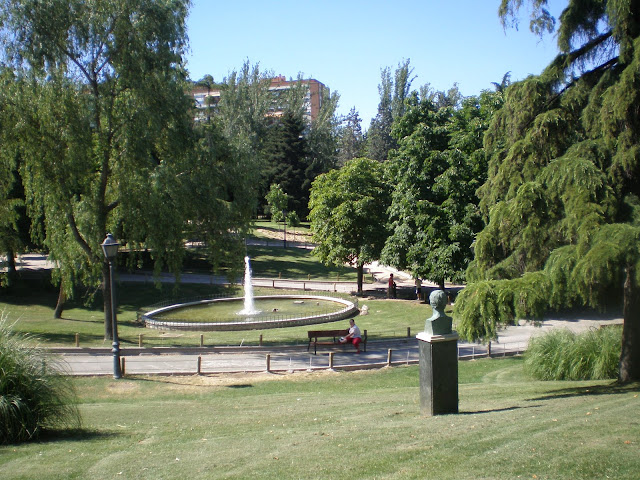
This is the park I go to most days to read or bask in the sun. It's a very nice park and only a few blocks from the apartment. Since a lot of people here don't have cars and walk everywhere, there are many many neighborhood parks in Madrid. A lot of people bring their dogs here to play and no one uses leashes except on puppies. Very different than what we're used to, but as a result all the dogs are very well behaved and friendly.

Finally, this is Plaza de Prosper- idad, the main plaza near the apartment, where our metro stop is. There are lots of benches and shade trees, as well as a play ground for the kiddies and a terrace cafe, so it's a pretty big hang out. The seniors all come out to chat in the late afternoons and early evenings and kids play soccer (sorry, football) here all day long. Watch out for flying balls!
 Here's a map to get an idea of where I live, although it probably wouldn't mean anything to you unless you know about the city. Basically I live 3 miles or so from the center. From an American perspective, I realize that that is not at all far. I practically have to drive that far to get to the nearest grocery store at home. But Madrid is really a pretty small city and being European, pretty compact. The "center" is probably only about 1 square mile. Maybe 2. And when you have to walk everywhere... I wouldn't say I live in a suburb, exactly. But I might go so far as "outskirts". It's kind of like... the center is Manhattan, and I live in Brooklyn. Which is certainly more "authentic". This is where the real Madrileños live. But getting to the action requires a taxi, the metro or a very long walk. It is a very nice, very safe neighborhood, though. Not even any crackheads or anything.
Here's a view of my front door.

Did I mention I live in a garage? That might sound like the terrible, though inevitable, fate of a college grad with no real income to speak of. And, in some ways, you would be right. But no worries, I'm not camped out in some abandoned building, keeping warm by lighting fires in garbage cans, carting around my meager possessions in an abandoned shopping cart. Not yet anyway.

This is what the door looks like after I use my garage door opener to get in the house. We having amazing stealth capabilities here. It can be fun to startle people by opening the door while they're loitering by it. It also has the added benefit of not having any stairs to climb, although that can't be good for my girlish figure.

This is the view from the front door. The apartment is actually quite large. The tradeoff for extra space is that we have only one window, in the kitchen, which opens out into a light well. We do not get a whole lot of natural light. If I leave the roll up door open we do have some opaque windows facing the street that give the illusion of daylight. Most leased apartments in Spain come furnished, or at least most of the ones I have seen, so most of what you can see comes with the place. Thankfully my landlady doesn't have terrible taste. She also fancies herself as something of an artist, so we have a rather eclectic assortment of her originals adorning the walls.

Here's the kitchen - where all the magic happens. When I got here I was impressed by it's classiness. "Oooo, stainless steel, how swank," thought I. How naive. As I have come to discover, stainless steal is an idiotic thing to make your kitchen out of unless you never actually USE your kitchen. Or if you're a professional chef and you have people who you pay special to come in and clean up for you after you've had your fun. But, seeing as I do (and I don't), the novelty of being able to watch myself cook quickly gave way to the reality of the stuff being impossible to keep clean. Add to that the fact that you have to use special cleaner or you'll scratch it (groan) and it's hard to muster up the energy to even bother. And it's not just food. Heaven forbid you actually touch one of the drawers to open it. Fingerprint city! No, this is a not a kitchen for the obsessive compulsive cleaner. Or maybe it's the perfect one... Regardless, it is a nice kitchen and serves it's purpose well.
Here is the yard:

Hahaha. No, really. And the lovely view as well. The one in the middle is the basil plant that I haven't completely killed yet. I attempted to grow more herbs, but unfortunately the lack of natural light was not kind to their tender seedling selves.
Here's a view of the dining room/living room from the kitchen...

Now we've come to the bathroom, an exciting part of any grand tour.

Here's my needlessly complicated shower.

You can actually have it shoot water straight into your face. I think maybe it's supposed to be massaging or something. It doesn't matter though because the hot water never lasts for more that 7 or 8 minutes, which is barely enough time for me to shampoo, condition and soap. When we moved in the landlady made a big deal about showing us that we had our own water heater with "100 liters of hot water just for us". As it turns out, 100 liters isn't all that much. And once you use it all up, it takes hours to heat up again. But it is nice and warm for those 7 or 8 minutes. At the last place it would stay warm indefinitely but only for alternating minutes with freezing cold (one minute of warm, one minute of freezing, one minute of warm, one of freezing, etc.). So I guess we're moving up in the world.

Here's my room, it was really hard to get a good angle here. Looking at it like this, it's rather boring. It's hard to get excited about decorating something when you know you'll just be leaving again in a few months. The mattress isn't very comfortable, but hey, it serves it's purpose.
 |
| Wow, thrilling. |
So that's the end of the grand tour of the apartment. I thought you might also be interested in my surroundings, so this is a photo of my street. It's a pretty quiet one-way road.

This is just a view of my walk home from the metro, I live one street over.

This is also the way to the park...

This is the park I go to most days to read or bask in the sun. It's a very nice park and only a few blocks from the apartment. Since a lot of people here don't have cars and walk everywhere, there are many many neighborhood parks in Madrid. A lot of people bring their dogs here to play and no one uses leashes except on puppies. Very different than what we're used to, but as a result all the dogs are very well behaved and friendly.

Finally, this is Plaza de Prosper- idad, the main plaza near the apartment, where our metro stop is. There are lots of benches and shade trees, as well as a play ground for the kiddies and a terrace cafe, so it's a pretty big hang out. The seniors all come out to chat in the late afternoons and early evenings and kids play soccer (sorry, football) here all day long. Watch out for flying balls!
Tuesday, June 17, 2008
A Matter of Life and Death
I've never really thought of this as one of those indulgently self-serving my-opinion-on-something-you-probably-don't-care-about blogs. As you all know, I do have very strong opinions about pretty much anything it's possible to have an opinion about, but in normal circumstances I wouldn't feel the need to thrust those upon my faithful readership, whether it exists or not.
However, I've read a few things in the past few days that have really gotten me thinking and, since there isn't anything interesting to report on here in Madrid anyway (with the exception of some sun, at long last), I've decided that venting my frustrations is probably more appropriate in this forum than in the mass of comments at the bottom of these news stories (the letters to the editor of the internet generation and, therefore, populated mainly by crazies who like to hear themselves talk).
I love google. Despite recent signs that they're making the inevitable fall to the dark side, they really know me. And as long as I refrain from thinking about how sinister and creepy that really is, I usually really enjoy the links they provide for me at the top of my gmail. Today it was an article about the high costs of premature births. If you don't feel like reading the whole article, the gist is basically that not only do premature infants, which account for about 13% of babies born in the U.S., eat up an incredible amount of financial resources (this is the emphasis, since it is a Business Week article) but that a huge proportion, especially of severely premature babies, suffer from moderate to severe birth defects for the rest of their lives. The piece tells the story of baby Ryan, who was born at 28 weeks and now suffers from a plethora of physical, neurological and learning disabilities. I was shocked to learn that babies born at 22 weeks are considered viable these days and (crossing our fingers here) doctors may be able to push that to 20 weeks in the next few years.
This may be incredibly insensitive of me, but I think we are finally going too far. At this rate, soon we'll be able to grow babies in incubators from conception. And although this is good news for my figure (haha), it is, at the very least, ethically questionable. Is it really responsible to save every single premature child? It might be hard to accept, but we are the Earth's children and it might serve us well to remember that mother knows best. Certainly there are extenuatiing circumstances sometimes - the mother's health is in danger or there is a terrible accident or some other calamity that prevents the baby from being carried any longer. But, in general, we have to accept that nature knows what it's doing. Miscarriages are natural. Yes, they can be devastating on an individual level, but rationally, they happen for a reason. That fetus was not viable, whether we can keep it alive in an incubator or not.
Even more disturbing was this 1991 article about how parents of premature infants have less and less say over what heroic measures are taken to save their children. I didn't find any more current articles in a quick search, but if this trend has continued, it's absolutely abhorrent. I can see where the rationale would come from in this pro-life society we live in, but that doesn't make it right. In this article, a mother was chastised by doctors after questioning "when do we say enough is enough" when her premature TRIPLETS suffered from serve brain hemmorhages that most often lead to cerebral palsy or severe retardation. From the article:
So why do we do this to our children? I'm not talking about a few weeks premature here. I am talking about severe prematurity. Is it really because we value the sanctity of life so dearly? Do we really just want to give these tiny, helpless, dying creatures a shot at the good life?
I hate to be cynical, but I think the answer lies in both of these articles and it comes down to that number one motivator. No, not love. Money.
It turns out that although insurance companies love denying the claims of 9/11 rescue workers, middle aged mothers dying of breast cancer, elderly patients who may have filled a form in incorrectly, and pretty much anyone else seeking medical care in the U.S. they pull out all the stops when it comes to keeping premature infants alive. This may be partially thanks to Federal regulations passed in 1985 with somewhat vague bereaucratic wording about how far doctors have to go to save infants. No doctor wants to be labeled a baby killer. But this is also probably because the insurance companies fear being labeled as "anti-life" by crazy evangelical groups. Also dead babies and grieving young parents are much more sympathetic plaintiffs in lawsuits than old people with lung cancer. The fact of the matter is that insurance companies will approve any and all heroic measures to save preemies, even highly experimental procedures.
Now, 17 years later, we can see in the Business Week article what the result of that is: Neonatal Intensive Care is a big time profit maker for hospitals, unlike the rest of their operations. It turns out that highly specialized, invasive medicine, the kind that insurance companies are guaranteed to approve, is fantastic for the bottom line. Need emergency care? Sorry, not a priority. But we will build new NICUs wherever we can find a few square feet to build a new state-of-the-art facility.
And if NICUs are such good money makers and, in this corporate age, hospitals have to figure out ways to be profitable, it makes me worry that too much is being done to save preemies not only because it is in their interest, but also because it is good business for the hospital. Why would you allow a parent cheat you out of hundreds of thousands of dollars worth of profit by suggesting you not take heroic measures?
It is true that all of this practice and experimentation has had some positive effects. We are now much better at keeping premature babies alive and have taken signiciant steps to reduce the chances of "complications", as they say. But at what cost? How many children and families have suffered from our overzealousness?
I'm not an advocate of genetic cleansing or anything and I'm not suggesting we go back to the days of leaving premature or disabled babies by an open window on a cold night, but I do think we should be able to trust our health care establishment to help us make good choices, not necessarily the most profitable choices. Some babies are surely better candidates for long term incubation and innumerable procedures than others. And if a parent doesn't want their child to suffer, they certainly should have that right.
Our practice of saving all premature babies, no matter what, is certainly not the only thing wrong with our health care system, but I think it does underscore the problem of a self-devouring system: hospitals are forced to emphasize acute care and very high specialization to stay afloat, discouraging healthy people to be interested in staying healthy, which raises health care costs, which the insurance companies pass on to the consumer through higher premiums and the denial of claims, as well as even more questionable meathods. Heaven forbid you don't have adequate insurance. It is not a sustainable system.
Now, in a mostly unrelated topic, let's venture to the other side of life. As you must know, Tim Russert, the well-known right-leaning (ahem) host of Meet the Press died of a massive coronary last Friday. And, of course, when someone dies it is time for everyone they ever disagreed with to posthumously bury the hatchet and praise their former foe, no matter how much they criticized them in life. The New York Daily News, which, by the way, I do not recommend reading, ever, hates it when we don't conform to this silly societal obligation, criticizing Arianna Huffington in this bizarre gossip (?) column.
Apparently his fans are upset that Huffington, an adversary of Russert's, waited several days to make her own posting acknowleging Russert's death and that, when she finally did, "her detached wistfulness didn't even amount to faint praise".
Sorry, people, but death, no matter how untimely or tragic, doth not a hero make. Why are we forced to churn out worthless sentimental bullshit whenever someone dies? Why should we praise someone in death who we wouldn't praise in life? Personally, I think it is an insult to the complex people we are and the nuanced ways we choose to live our lives to gloss over all the relationships, conflicts and, yes, mistakes that make us whole and real. For someone who made a career out of interviewing people of disparate perspectives and encouraging people to argue with each other, I would think Russert would agree.
It is possible to empathize with the family, reflect on the fagility of life and appreciate the days we have without selling out our beliefs. Or it should be anyway.
However, I've read a few things in the past few days that have really gotten me thinking and, since there isn't anything interesting to report on here in Madrid anyway (with the exception of some sun, at long last), I've decided that venting my frustrations is probably more appropriate in this forum than in the mass of comments at the bottom of these news stories (the letters to the editor of the internet generation and, therefore, populated mainly by crazies who like to hear themselves talk).
I love google. Despite recent signs that they're making the inevitable fall to the dark side, they really know me. And as long as I refrain from thinking about how sinister and creepy that really is, I usually really enjoy the links they provide for me at the top of my gmail. Today it was an article about the high costs of premature births. If you don't feel like reading the whole article, the gist is basically that not only do premature infants, which account for about 13% of babies born in the U.S., eat up an incredible amount of financial resources (this is the emphasis, since it is a Business Week article) but that a huge proportion, especially of severely premature babies, suffer from moderate to severe birth defects for the rest of their lives. The piece tells the story of baby Ryan, who was born at 28 weeks and now suffers from a plethora of physical, neurological and learning disabilities. I was shocked to learn that babies born at 22 weeks are considered viable these days and (crossing our fingers here) doctors may be able to push that to 20 weeks in the next few years.
This may be incredibly insensitive of me, but I think we are finally going too far. At this rate, soon we'll be able to grow babies in incubators from conception. And although this is good news for my figure (haha), it is, at the very least, ethically questionable. Is it really responsible to save every single premature child? It might be hard to accept, but we are the Earth's children and it might serve us well to remember that mother knows best. Certainly there are extenuatiing circumstances sometimes - the mother's health is in danger or there is a terrible accident or some other calamity that prevents the baby from being carried any longer. But, in general, we have to accept that nature knows what it's doing. Miscarriages are natural. Yes, they can be devastating on an individual level, but rationally, they happen for a reason. That fetus was not viable, whether we can keep it alive in an incubator or not.
Even more disturbing was this 1991 article about how parents of premature infants have less and less say over what heroic measures are taken to save their children. I didn't find any more current articles in a quick search, but if this trend has continued, it's absolutely abhorrent. I can see where the rationale would come from in this pro-life society we live in, but that doesn't make it right. In this article, a mother was chastised by doctors after questioning "when do we say enough is enough" when her premature TRIPLETS suffered from serve brain hemmorhages that most often lead to cerebral palsy or severe retardation. From the article:
When...she asked the neurosurgeon if he would consider not reviving the baby if he went into cardiac arrest. She said the doctor replied, "I'm not your executioner."When that article was written, the mother had quit her job to stay at home and care for the three boys, then 4 1/2 years old, all with seizures and cerebral palsy, one blind and another paralyzed on one whole side of his body.
So why do we do this to our children? I'm not talking about a few weeks premature here. I am talking about severe prematurity. Is it really because we value the sanctity of life so dearly? Do we really just want to give these tiny, helpless, dying creatures a shot at the good life?
I hate to be cynical, but I think the answer lies in both of these articles and it comes down to that number one motivator. No, not love. Money.
It turns out that although insurance companies love denying the claims of 9/11 rescue workers, middle aged mothers dying of breast cancer, elderly patients who may have filled a form in incorrectly, and pretty much anyone else seeking medical care in the U.S. they pull out all the stops when it comes to keeping premature infants alive. This may be partially thanks to Federal regulations passed in 1985 with somewhat vague bereaucratic wording about how far doctors have to go to save infants. No doctor wants to be labeled a baby killer. But this is also probably because the insurance companies fear being labeled as "anti-life" by crazy evangelical groups. Also dead babies and grieving young parents are much more sympathetic plaintiffs in lawsuits than old people with lung cancer. The fact of the matter is that insurance companies will approve any and all heroic measures to save preemies, even highly experimental procedures.
Now, 17 years later, we can see in the Business Week article what the result of that is: Neonatal Intensive Care is a big time profit maker for hospitals, unlike the rest of their operations. It turns out that highly specialized, invasive medicine, the kind that insurance companies are guaranteed to approve, is fantastic for the bottom line. Need emergency care? Sorry, not a priority. But we will build new NICUs wherever we can find a few square feet to build a new state-of-the-art facility.
And if NICUs are such good money makers and, in this corporate age, hospitals have to figure out ways to be profitable, it makes me worry that too much is being done to save preemies not only because it is in their interest, but also because it is good business for the hospital. Why would you allow a parent cheat you out of hundreds of thousands of dollars worth of profit by suggesting you not take heroic measures?
It is true that all of this practice and experimentation has had some positive effects. We are now much better at keeping premature babies alive and have taken signiciant steps to reduce the chances of "complications", as they say. But at what cost? How many children and families have suffered from our overzealousness?
I'm not an advocate of genetic cleansing or anything and I'm not suggesting we go back to the days of leaving premature or disabled babies by an open window on a cold night, but I do think we should be able to trust our health care establishment to help us make good choices, not necessarily the most profitable choices. Some babies are surely better candidates for long term incubation and innumerable procedures than others. And if a parent doesn't want their child to suffer, they certainly should have that right.
Our practice of saving all premature babies, no matter what, is certainly not the only thing wrong with our health care system, but I think it does underscore the problem of a self-devouring system: hospitals are forced to emphasize acute care and very high specialization to stay afloat, discouraging healthy people to be interested in staying healthy, which raises health care costs, which the insurance companies pass on to the consumer through higher premiums and the denial of claims, as well as even more questionable meathods. Heaven forbid you don't have adequate insurance. It is not a sustainable system.
Now, in a mostly unrelated topic, let's venture to the other side of life. As you must know, Tim Russert, the well-known right-leaning (ahem) host of Meet the Press died of a massive coronary last Friday. And, of course, when someone dies it is time for everyone they ever disagreed with to posthumously bury the hatchet and praise their former foe, no matter how much they criticized them in life. The New York Daily News, which, by the way, I do not recommend reading, ever, hates it when we don't conform to this silly societal obligation, criticizing Arianna Huffington in this bizarre gossip (?) column.
Apparently his fans are upset that Huffington, an adversary of Russert's, waited several days to make her own posting acknowleging Russert's death and that, when she finally did, "her detached wistfulness didn't even amount to faint praise".
Sorry, people, but death, no matter how untimely or tragic, doth not a hero make. Why are we forced to churn out worthless sentimental bullshit whenever someone dies? Why should we praise someone in death who we wouldn't praise in life? Personally, I think it is an insult to the complex people we are and the nuanced ways we choose to live our lives to gloss over all the relationships, conflicts and, yes, mistakes that make us whole and real. For someone who made a career out of interviewing people of disparate perspectives and encouraging people to argue with each other, I would think Russert would agree.
It is possible to empathize with the family, reflect on the fagility of life and appreciate the days we have without selling out our beliefs. Or it should be anyway.
Tuesday, June 10, 2008
Seasons Greetings
This will peg me as a California girl for sure, but I have to admit I've never really understood the seasons before. Winter lasts until March? Summer doesn't begin until late June??? I just always figured that the seasons were kind of... off. Maybe so they'd match up with the solstices? Honestly, I never really gave it very much thought.
Even in Sacramento, where we have something approaching seasons and temperature variations, it just didn't always make a lot of sense. And southern California? Forget about it. Everyone knows that the winter is the best time for the beach.
So imagine my surprise upon realizing that there may be some factual basis for our seasonal lore. Take for example the idea that March "comes in like a lion and leaves like a lamb". Although I could always understand generally what this would mean, I had certainly never experienced it and, I think, got it into my head that the people who make these things up have somewhat of a penchant for exaggeration.
The one age-old saying I did not find to be true here in Madrid was the classic "April showers bring May flowers". I was hopeful, but it turned out that the April showers just brought more showers.
In any case, I'm still waiting for summer.
Even in Sacramento, where we have something approaching seasons and temperature variations, it just didn't always make a lot of sense. And southern California? Forget about it. Everyone knows that the winter is the best time for the beach.
So imagine my surprise upon realizing that there may be some factual basis for our seasonal lore. Take for example the idea that March "comes in like a lion and leaves like a lamb". Although I could always understand generally what this would mean, I had certainly never experienced it and, I think, got it into my head that the people who make these things up have somewhat of a penchant for exaggeration.
The one age-old saying I did not find to be true here in Madrid was the classic "April showers bring May flowers". I was hopeful, but it turned out that the April showers just brought more showers.
In any case, I'm still waiting for summer.
Sunday, June 8, 2008
My big night out
Last night I went out to dinner, which is not something I do very frequently. It's expensive and generally I enjoy the food I cook just as well. But it is nice to have someone wait on you and do the dishes. So anyway, I was out having dinner. Quite embarassingly, this was an "american" themed restaurant, but that's the only place you can go for a real steak or some ribs. Not to mention the free refills. It turns out I am an American, whoda thunk?
About halfway into our meal, this enormous group of about 20 come in. No big deal. Then they proceed to sit all 10 of the children at their own massive table in the middle of the restaurant before the adults retreated back to their own massive table somewhere in the back. Great. Thanks. Aren't children annoying to eat with? Don't they get in the way of all your adulty fun? Instead of, say, leaving them at home or (gasp) not having them in the first place, I now have an excellent idea, courtesy of Spanish child-rearing - Just abandon them and let the rest of the patrons deal with your rugrats while you go enjoy your beer.
Now I like children and I've never been able to understand people who claim to hate children, since we all were children at one point and one day even these carefree annoying brats will be just as disillusioned and dead inside as you are. Plus, if we want the human race to continue (debateable), we'll have to deal with them.
That said, I shouldn't need to enjoy the wonders of unsupervised childhood while I'm trying to eat. I sure hope those adults had a good enough time to justify me having to sit through the 15 minute cell phone ringtone symphony, 5th movement, courtesy of little José. And I know you're trying to be a good parent and keep your child healthy, so I understand why you tell them they can't have a soda. But you can walk away from the tantrum that ensues. We can't. Neat trick. Furthermore, if your children are not old enough to read a menu or use a fork properly, you probably shouldn't be leaving them to their own devices. They could choke or something. Plus they WILL use their chicken fingers to chicken fingerpaint all over the table with the ketchup.
And Spanish people don't even tip.
About halfway into our meal, this enormous group of about 20 come in. No big deal. Then they proceed to sit all 10 of the children at their own massive table in the middle of the restaurant before the adults retreated back to their own massive table somewhere in the back. Great. Thanks. Aren't children annoying to eat with? Don't they get in the way of all your adulty fun? Instead of, say, leaving them at home or (gasp) not having them in the first place, I now have an excellent idea, courtesy of Spanish child-rearing - Just abandon them and let the rest of the patrons deal with your rugrats while you go enjoy your beer.
Now I like children and I've never been able to understand people who claim to hate children, since we all were children at one point and one day even these carefree annoying brats will be just as disillusioned and dead inside as you are. Plus, if we want the human race to continue (debateable), we'll have to deal with them.
That said, I shouldn't need to enjoy the wonders of unsupervised childhood while I'm trying to eat. I sure hope those adults had a good enough time to justify me having to sit through the 15 minute cell phone ringtone symphony, 5th movement, courtesy of little José. And I know you're trying to be a good parent and keep your child healthy, so I understand why you tell them they can't have a soda. But you can walk away from the tantrum that ensues. We can't. Neat trick. Furthermore, if your children are not old enough to read a menu or use a fork properly, you probably shouldn't be leaving them to their own devices. They could choke or something. Plus they WILL use their chicken fingers to chicken fingerpaint all over the table with the ketchup.
And Spanish people don't even tip.
Friday, June 6, 2008
Getting sick in Spain and various other health-related observations
This past week our apartment was struck by the plague. Miraculously, I managed to escape virtually unscathed, with only a day or so of runny nose to complain about. It must be something about my crap diet and complete lack of exercise that gives me such an impenetrable immune system. Although I was lucky to be spared, being the only well one in a house of death and disease leaves one with some rather unfortunate responsibilities - tending to the cholera victims.
Actually I don't know what it was that descended upon us with such savage delight, but my nursely duties left me with plenty of time to diagnose my patients with the aid of The Internet. The Internet is a wonderful thing. One of my favorite things is using it figure out all the incredibly rare diseases/conditions/disorders I might have. Feeling tired? It's probably multiple sclerosis. Have a headache? Definitely a brain tumor. Upset tummy? Crohn's disease. I could go on and on. Thanks to these amazing medical skillz I was able to tentatively identify symptoms of several fairly serious conditions, but finally came back to my original diagnosis of "nasty virus".
Amid all the neediness and insatiable whining/moaning on the ward, I did learn several things about the Spanish and their take on healthcare.
First of all, brace yourself, there are no over the counter drugs in Spain, at least not in the way we're used to. It is impossible to anonymously drag yourself into your local drug store and surreptitiously hide your anti-diarrhea medicine in amoungst your orange juice and chicken soup. No no no. Instead you must march into a special pharmacy (during normal Spanish business hours - i.e. hardly ever) and describe the symptoms in detail to a white-coated pharmacist, who, just to make you feel more embarassed, is always, always a very pretty and well made-up woman, who will then proceed to explain that you're not really that sick. The spaniards are very into allowing the body's natural healing processes to be in control.
Don't get me wrong. In principle, this is an amazingly refreshing perspective. We do overmedicate. And allowing the plebs to medicate themselves probably isn't really that smart, when I really think about it. However, listening to a pharmacist lecture you on the body's natural healing processes and refuse to sell you medicine is not really that reassuring when you just want something to MAKE IT STOP NOW nor that helpful when you have to return home to the black death with nothing in hand save a few tylenol and box of disgusting salty gatorade "rehydrating" juice. Principles go out the window when you have to go home and face the anthrax.
I've been to the pharmacy a few times now and I can't understand how they stay in business when they always refuse to sell you their wares. They must make up for it in toothbrushes or something.
Secondly, I have no idea how to go about getting to a doctor here. In a few absurdly melodramatic moments, I was ordered to "call an ambulance". This was ridiculous for many reasons. Where I come from, ambulances are reserved pretty much exclusively for actual life threatening emergencies. Or in my mind they are anyway. Also where I come from, ambulances are expensive. And they will charge you, whether you're the one who called them or not. So if you aren't in danger of dying in the next few minutes, you will manage to drag yourself into your car, into a bus, into a cab before you are reduced to calling an ambulance. Ambulances are good for when you're pinned under something heavy.
Rationally I knew that emergency healthcare is free here and so should have been able to make the logical leap that ambulances would also be provided courtesy of the government, but I was so trapped in my American corporate healthcare mindset that I didn't even realize it. And just think - the Spanish aren't out abusing their free ambulance service or anything. It seems as though emergency care could be provided for free without the risk of freeloaders using emergency vehicles as some kind of private taxi service.
Although I did manage to keep anyone from calling any ambulances, I did do some research about seeing a doctor in Spain, just to have the knowledge if it were ever actually necessary. From what I've seen of the Spanish approach to health, they probably wouldn't do anything anyway. But I found it interesting that one of the principle complaints about the socialized healthcare in Spain (and other european nations) is the long wait time in the emergency room. This is also one of the primary arguments used against universal healthcare in the US - the standard or care isn't as high, you will have to wait for hours, etc. I want to know what American hospitals these critics have been going to, must be fancy rich people credit-check-in-the-parking-lot hospitals. In my world, emergency room visits always involve long waits, even in our sacred free market. I don't see anyone's demand for shorter waits affecting anything back home either.
Politics aside, there are a few other observations I've made about health in this country in my time here.
Chocolate is considered health food. So are fish sticks and cheese. I don't mean that people talk about them as if they are health food, that I don't really know. But I do know they are marketed as healthfood. Did you know, for example, that the milk in chocolate has calcium? And protein? Or that the fish deep under that breading is good for you? And cheese, well it's practically made of milk. Those peta anti-milk campaigners would not get far in Spain. I know that in America we certainly market our fair share of unhealthy things as being healthy, but the Spanish have taken it to a truly absurd level. Plus, actually healthy products don't blare their healthiness at you, like you would see in American supermarkets. Bran flakes are just bran flakes, no special health benefit. But chocolate. Yes. Feed your kids tons of chocolate. It does a body good.
Europeans like to make fun of Americans for being fat. Yes, ha. Ha. Ha. I know, I live there. Oh yes, we invented fast food, packaged food, processed food, frozen food, whatever disgrace it is you want to throw in my face today. But the fact of the matter is that Americans eat junk food knowing full well how bad it is for them. We just don't care. Whatever. Whereas the Spanish can (and will) put a few cups of lard in something and then call it healthfood just because one ingredient happens to be vaguely healthy. And they love our convenience food. There are entire stores that are dedicated solely to frozen foods. And what's that around the corner? Not a McDonalds?! Just wait a few decades, they'll catch up.
Anyway, the plague has finally lifted and things are getting back to normal around here. The rain has mercifully stopped, at least untl later this week, so I'd beter go out and enjoy it.
Actually I don't know what it was that descended upon us with such savage delight, but my nursely duties left me with plenty of time to diagnose my patients with the aid of The Internet. The Internet is a wonderful thing. One of my favorite things is using it figure out all the incredibly rare diseases/conditions/disorders I might have. Feeling tired? It's probably multiple sclerosis. Have a headache? Definitely a brain tumor. Upset tummy? Crohn's disease. I could go on and on. Thanks to these amazing medical skillz I was able to tentatively identify symptoms of several fairly serious conditions, but finally came back to my original diagnosis of "nasty virus".
Amid all the neediness and insatiable whining/moaning on the ward, I did learn several things about the Spanish and their take on healthcare.
First of all, brace yourself, there are no over the counter drugs in Spain, at least not in the way we're used to. It is impossible to anonymously drag yourself into your local drug store and surreptitiously hide your anti-diarrhea medicine in amoungst your orange juice and chicken soup. No no no. Instead you must march into a special pharmacy (during normal Spanish business hours - i.e. hardly ever) and describe the symptoms in detail to a white-coated pharmacist, who, just to make you feel more embarassed, is always, always a very pretty and well made-up woman, who will then proceed to explain that you're not really that sick. The spaniards are very into allowing the body's natural healing processes to be in control.
Don't get me wrong. In principle, this is an amazingly refreshing perspective. We do overmedicate. And allowing the plebs to medicate themselves probably isn't really that smart, when I really think about it. However, listening to a pharmacist lecture you on the body's natural healing processes and refuse to sell you medicine is not really that reassuring when you just want something to MAKE IT STOP NOW nor that helpful when you have to return home to the black death with nothing in hand save a few tylenol and box of disgusting salty gatorade "rehydrating" juice. Principles go out the window when you have to go home and face the anthrax.
I've been to the pharmacy a few times now and I can't understand how they stay in business when they always refuse to sell you their wares. They must make up for it in toothbrushes or something.
Secondly, I have no idea how to go about getting to a doctor here. In a few absurdly melodramatic moments, I was ordered to "call an ambulance". This was ridiculous for many reasons. Where I come from, ambulances are reserved pretty much exclusively for actual life threatening emergencies. Or in my mind they are anyway. Also where I come from, ambulances are expensive. And they will charge you, whether you're the one who called them or not. So if you aren't in danger of dying in the next few minutes, you will manage to drag yourself into your car, into a bus, into a cab before you are reduced to calling an ambulance. Ambulances are good for when you're pinned under something heavy.
Rationally I knew that emergency healthcare is free here and so should have been able to make the logical leap that ambulances would also be provided courtesy of the government, but I was so trapped in my American corporate healthcare mindset that I didn't even realize it. And just think - the Spanish aren't out abusing their free ambulance service or anything. It seems as though emergency care could be provided for free without the risk of freeloaders using emergency vehicles as some kind of private taxi service.
Although I did manage to keep anyone from calling any ambulances, I did do some research about seeing a doctor in Spain, just to have the knowledge if it were ever actually necessary. From what I've seen of the Spanish approach to health, they probably wouldn't do anything anyway. But I found it interesting that one of the principle complaints about the socialized healthcare in Spain (and other european nations) is the long wait time in the emergency room. This is also one of the primary arguments used against universal healthcare in the US - the standard or care isn't as high, you will have to wait for hours, etc. I want to know what American hospitals these critics have been going to, must be fancy rich people credit-check-in-the-parking-lot hospitals. In my world, emergency room visits always involve long waits, even in our sacred free market. I don't see anyone's demand for shorter waits affecting anything back home either.
Politics aside, there are a few other observations I've made about health in this country in my time here.
Chocolate is considered health food. So are fish sticks and cheese. I don't mean that people talk about them as if they are health food, that I don't really know. But I do know they are marketed as healthfood. Did you know, for example, that the milk in chocolate has calcium? And protein? Or that the fish deep under that breading is good for you? And cheese, well it's practically made of milk. Those peta anti-milk campaigners would not get far in Spain. I know that in America we certainly market our fair share of unhealthy things as being healthy, but the Spanish have taken it to a truly absurd level. Plus, actually healthy products don't blare their healthiness at you, like you would see in American supermarkets. Bran flakes are just bran flakes, no special health benefit. But chocolate. Yes. Feed your kids tons of chocolate. It does a body good.
Europeans like to make fun of Americans for being fat. Yes, ha. Ha. Ha. I know, I live there. Oh yes, we invented fast food, packaged food, processed food, frozen food, whatever disgrace it is you want to throw in my face today. But the fact of the matter is that Americans eat junk food knowing full well how bad it is for them. We just don't care. Whatever. Whereas the Spanish can (and will) put a few cups of lard in something and then call it healthfood just because one ingredient happens to be vaguely healthy. And they love our convenience food. There are entire stores that are dedicated solely to frozen foods. And what's that around the corner? Not a McDonalds?! Just wait a few decades, they'll catch up.
Anyway, the plague has finally lifted and things are getting back to normal around here. The rain has mercifully stopped, at least untl later this week, so I'd beter go out and enjoy it.
Subscribe to:
Posts (Atom)