Hello everyone and thanks for all of my birthday wishes! I had a pretty good day, although pretty "normal" (just how I like it) and had Galician octopus for dinner. It seems like it's been weeks since it stopped raining in Madrid and, since I've been left to my own devices for a few days, I decided to take off and find some sunshine. So here I am in Granada, which is in Andalusia, a region of southern Spain. Granada was once the largest and most powerful city in Europe (when it served as a Moorish capital). Now it is more of a sleepy university city but it still has plenty of history, most notable the Alhambra, a huge castle/fortress/palace compound. It's going to be a little pricey to get in tomorrow but I'm going to have to suck it up. I heard that it was almost considered one of the 7 wonders of the world but didn't quite make it, so I guess you could say it's the eighth wonder.
I'll post more when I get home on Tuesday and have time to post pictures and go into more detail. I'm on a public hostel computer right now, so I should be brief. Thinking of you all...
Sunday, May 25, 2008


Monday, May 19, 2008
We'll Always Have Morocco
**Warning! Extremely long post follows!**
 Please forgive the tardiness of this report. I returned safely from Marrakesh on Tuesday night but have been too lazy to write what I imagine is going be a very long post back to the folks at home. Especially since Madrid has been celebrating the day of its patron saint, San Isidro, all week. Saints’ days are incredibly important in Spain; each city and village (not to mention neighborhood!) has its own patron saint (and each saint has a special day reserved for it) and the celebration turns into a week-long affair with free concerts, partying in the streets, traditional costumes, fireworks, bullfighting and everything else essentially Spanish. Unfortunately I have learned that April and May are rather wet months here, which is distressing for me, coming from what is actually a seasonless desert, so I haven’t gone out as much as I ought to have.
Anyway! This isn’t really supposed to be about Spanish fiestas but they are very interesting and extremely culturally important here so I thought I should mention them. The Spaniards enjoy them so much that they will fiesta for any excuse. I hear that from now until September you can find some kind of fiesta somewhere in the city, not to mention the rest of the country.

But back to Morocco. I had a really great time, but it was extreme- ly… chaotic. Our already late flight was delayed by 2 hours, so we didn’t arrive in Marrakesh until midnight. I would mention how quaint it was to have to walk across the tarmac to the terminal, but they still do that in Spain too. The airport was very modern and new-looking, which seemed to be a contradiction of sorts. I came to see third world squalor not some Frank Lloyd Wright monstrosity! But clearly Marrakesh does a HUGE tourist trade, so I guess this was their way of making a good impression on us moneyed Europeans. The customs office was a revealing first look at how the country works: they had one of those huge fancy scanners but there was no one watching the monitor or even checking to see if we all ran our bags through it (or even to tell us whether we were supposed to or not). Instead they seemed to rely largely on the tried and true technique of pulling aside “hippie” looking people for intense, public interrogations. Quite frankly, though, who smuggles things into Morocco?
We had to change our money into the local currency, the Moroccan dirham, at the airport since the country strictly controls it and, therefore, it is unavailable for purchase outside the country. One euro is equivalent to roughly 11 dirham (although we mainly relied on a 10-1 ratio to make calculations easier) and one dollar, about 7 or 8 dirham. Gotta love that weak dollar.

Once outside we encountered one of the country’s native species: the pushy and over- zealous cab driver. These guys flock around any tourist they see and fight each other to ask in any language they can think of (to their credit, they know quite a few; maybe I should be a Moroccan cabbie) if you want a cab. I think the goal is to so overwhelm you that you forget how much they’re overcharging you. The best course of action is to be prepared to tell them forcefully to buzz off and then take a moment to think. You can usually haggle with the cab drivers, but they’re clever and when they know they’ve got you – like from an airport or bus station – they seem to kind of gang up and all have a previously agreed on price, which is much higher than it ought to be. If you can get someone to offer a lower price in this situation, they will probably be shunned by their cabbie brethren. Thankfully we were able to take the bus for 20 dirham each to the city center (something my guidebook, which turned out to be essentially useless, told me not to count on) so we didn’t have to deal with it – yet.
On the dark bus ride to the center, I tried to catch my first glimpse of Africa. What most struck me was how much open space there is and, as an American, I’m usually more accustomed to open spaces than Europeans. It reminded me of Las Vegas actually, you can have a mile or two of nothing, just dust and cacti, and then something, and then more dust.
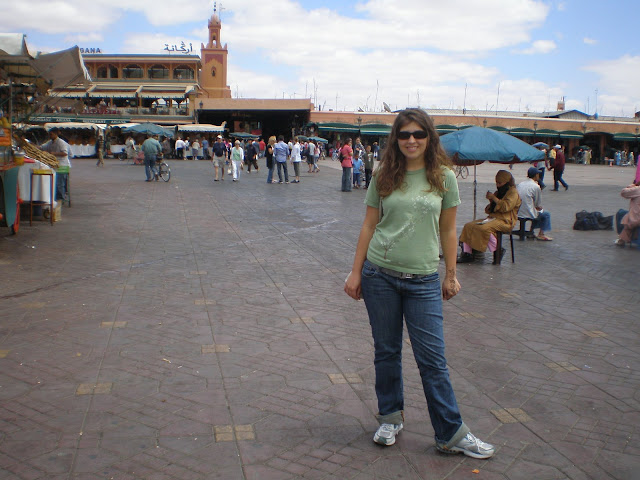
Morocco is essentially divided into two parts – the old medina (the center) and the nouvelle ville, the much more modern French colonial section outside the old city walls. It is most traditional to stay in a “riad”, which is best described as a guesthouse. They generally have very few rooms which are built around a central courtyard and are supposed to be known for their excellent service and food. Since I had heard that you could find excellent riads at a much cheaper price if you waited to find one until you arrived, I had booked only one night at what purported to be a backpackers’ hostel. It had…dubious reviews, to say the least. The map provided by the hostel to our check in location was woefully inadequate (think unlabeled lines drawn in MS Word) so we wandered into the dense network of streets to see if we stumbled upon anything. It was very late, so the narrow streets were almost deserted except for the many stray cats scrounging in the garbage and the occasional motorbike careening around at breakneck speeds. Eventually we found a Moroccan boy to take us to the place, guiding seeming to be one of the primary occupations of youngish Moroccan boys, where he then extorted us for 50 dirhams, which was way too much, but I was not in charge of the money at this point.

The idea was to check in at this place and then walk around the corner to the hostel and stay there. But the lad checking us in, who pretended to speak much better English than he actually did, managed to convince us to stay at this riad instead for twice as much, but it was a private room with a real bathroom, so it was probably worth it. I had the feeling that this was their usual racket though – lure us in with the cheap price at the other place and then convince us to stay at the more expensive one. But maybe that’s a cynical view. The room was nice enough, only one cockroach which was quickly vanquished, but it ended up being too nice to inspire me to go find somewhere better and cheaper, just because it’s a time-consuming hassle to wander around trying to find another place when you have a limited amount of time and you’re staying somewhere that isn’t overtly revolting. We ended up staying there for three nights, which was good enough cause we didn’t really plan on spending much time there anyway, but next time I would definitely plan more in advance and even pay a bit more for the authentic experience, since I got the feeling that our riad, if you could really call it that, was much more of a money-making venture than most family-run riads.

The best part about our riad was the location. The night before, the streets had been deserted, but the next morning we stepped out of the door right into the middle of the vibrant street market that dominates much of the central medina. Storefronts that had been shut tight the night before now spilled into the street. One of the best things about Morocco, I thought, is that you can get real souvenirs. There are very few places that sell what we would normally think of as souvenirs – t-shirts, postcards, magnets, keychains – but many places that sell authentic(ish) Moroccan tea sets, tobacco pipes, clothing, lighting, spices, art and, of course, carpets. Just wandering around and looking at the stuff was the best part.
The unfortunate thing is that many of the shopkeepers are just as pushy and obnoxious as the cabbies so you don’t want to stop to admire their wares, especially ones you would never ever actually want to buy but just want to look at. The shopkeepers promise to offer you a “very good price” (hahaha, right) but find it hard to understand that there is no price you would be willing to pay for something you don’t even want. They also think it’s funny to use English phrases (or German if you’re German, etc.) “it’s bloody brilliant!” but I’m not sure if this is supposed to draw us in or make fun of us.
Historically, similar shops have always grouped together, forming what are known as souqs in the medina. Since it is a desert country, the roads in the souqs are generally covered to provide shade. There is an olive souq, a dyers’ souq, a spice souq, a carpet souq, a clothing souq, even a high-tech souq! You could just wander around all day. The traffic on the street is the crazy part! Cars aren’t allowed in most of the medina – they might not fit down the streets! But there are plenty of tourists, motorbikes and donkey carts (yup) to keep you on your toes. I was nearly mowed down by one especially hurried cart and had the bruise to prove it too.

The food is always my favorite part. I am a huge fan of street meat (that is, meat sold from stands in the street, not meat that has been lying in the street, although I might consider it) so for lunch one day we bought a huge chunk of roast lamb. Leg? Rump? It’s hard to say… you sprinkle a mixture of salt and cumin on it and devour it with some Moroccan bread. The closest thing I can think of to Moroccan bread is the Mexican torta bread. It’s leavened more than a pita, but less than other breads. We had met some American kids in our hostel who were too afraid of the food and water that they had brought their own. Needless to say, they were horrified. But it was tasty. For dinner I had couscous with camel meat, which was good and rather like lamb.
The next day I tried a Moroccan specialty – a chicken tagine. A tagine is a ceramic mini oven with a pointy lid. You put all of your ingredients together inside and they cook together over a single burner. I’m guessing that this is a traditional nomadic way of cooking (as the native Berbers are traditionally a nomadic people) which allowed you to have a nice roasted meal that would cook itself without having to have a whole oven. It probably also helps to keep things cool in the summer. This is somewhat of a tangent, but these people really know how to live in such an extreme environment. The traditional garb for men and women is a long robe with a pointy hood (which was the inspiration for the robes in Star Wars). This may seem hot to us – we take off clothes to keep cool – but really it provides shade and protects them from the dry hot summer sun.

Getting back on task, my most anticipated meal was at the food stalls in the Djemma el Fna, the famous (world heritage site) central square. I was looking forward to seeing the square in general. Our riad was right around the corner and I had spent weeks reading about the performers who have gathered in the square for centuries – snake charmers, belly dancers, storytellers. I found the square to be rather disappointing in general, though, because it is where the pushiest, most obnoxious, greediest Moroccans seem to gather. One time it cost us 10 euros just to walk across the square. These people will not listen to “no”, they will gather around you and fling their wares or act on you against your will and despite the fact that you repeatedly tell them “no, go away”.

First it was a guy with a monkey. He was cool. He had a product. I didn’t mind paying him for a photo. Then these ridiculous clowns (? I’m actually not sure what they were) tried to accost us. I just kept walking, so they promised me a “free” picture. After I took it, they demanded money! Another time a henna artist came up to me, clenched my wrist and wouldn’t let it go even when I yelled no at her and tried to wrench my hand away. By that time she had already henna-d me and if I kept moving my hand it was going to look like some three year old got hold of some permanent markers and drew all over me, so I let her do it. Then she had the audacity to ask for 300 dirham. I just laughed. Finally I just had to start being rude to them because it was the only way they would leave me alone. That didn’t even always work. These people have thick skin. The best thing I found to do was to avoid the square if at all possible. When it was unavoidable, we walked quickly, with our heads down, around the edge of the square, rather than through the middle. I did see a few snake charmers, but I only dared to steal a glance for fear they might shake me down for everything I had. To be fair, I think the people with actually interesting and genuine acts probably aren’t such jerks, but I didn’t want to risk it.

Thankfully the food stalls were a different story. Each stall did have its own pushy salesman trying to force you into eating at his stall, but they were nothing compared to the others. Every evening these people set up and then tear down these elaborate stalls, complete with benches for seating, awnings, lighting and fairly extensive menus. We had a traditional Moroccan lamb stew known as “bachelor’s stew” and some kebabs along with an assortment of olives and Moroccan salads. It almost made up for my disappointment about the rest of the square. I wish we had cheap, quality food stalls here.

On our second day, we walked out into the Nouvelle Ville, stopping at the Koutoubia Mosque on the way. Quite frankly, I am not normally into seeing beautiful old buildings when I’m on vacation. I only went into one church on the whole camino last summer. It's really just not my thing. Nonetheless, it was nice to see it up close (foreigners aren’t allowed inside most mosques in Morocco). The most striking feature is the tower which towers over the rest of the medina. Although it probably isn’t really very tall by our standards, it looks most impressive rising from a city made up mostly of 2 or 3 story buildings. It was probably prettiest when it is lit up at night though.
The nouvelle ville was much about as different from the medina as it could possibly be, with wide boulevards and French inspired roundabouts. But if you thought that roundabouts were insanity in Paris, you obviously haven’t seen a third world roundabout. In Morocco road traffic is not limited to cars and buses. Oh no. You also have to worry about the motorbikes racing through traffic, sometimes with small (as in 2 or 3 years old) helmet-less children on the back, desperately trying to hang on to their mother or father. Then there are the horse drawn carriages. Don’t forget the slow moving donkey carts. Or the police who pull people over in the middle of the street, leaving the rest of the traffic to swerve around them. There also aren’t really any cross walks. Or at least not any that anyone pays attention to. After observing the natives, the best thing to do seemed to be to follow one of them out into the traffic, moving between traffic like some real life game of Frogger until (hopefully) you finally reach the other side. It’s really hard for me to adequately capture the true horror that crossing a Marrakeshi street can be.

The new city didn’t have nearly as much old world charm as the medina – this is where you can get your Pizza Hut, KFC or McDonalds fix while shopping at some European chain stores. It’s also where many of the real Moroccans live. And since there isn’t a mosque every five feet, like in the medina, there are actually bars and clubs in the new city (no alcohol within view of a mosque, out of respect for Islamic law). Best of all, there is actually real nature – trees and even the occasional grass.
We caught a taxi back to the center. How much will it be Mr. Cabdriver? Whatever Allah wills. Hahaha, you Moroccan cabbies sure are funny…
Back on our rooftop terrace, we pried the tops off our newly acquired beers just as the sunset call to prayer rose up around us from all sides. Five times a day, every mosque broadcasts a prayer over loudspeakers reminding good muslims everywhere to stop, drop and pray. I didn’t actually notice that many heeding the call. But sitting in the middle of four or five different calls to prayer is a pretty surreally awesome experience. Of course when the wind kicked up a little we looked to the beers in our hands and worried that God might be angry with us.

We decided to spend our last night in the beach town of Essaouira, about 100 miles and a 2 and a half hour bus ride from Marrakech. We called ahead to the bus company recommended by my guidebook and they told us that there was a bus leaving at 10:45 in the morning. Hooray! We set out the next morning for the central bus station, the Gare Routiere, in good spirits. Until it turned out that we had been lied to about both the time and the station, meaning that we were not only late for the bus, but miles away from where it actually departed from. Disappointed, but unshaken, we bought tickets with a more authentic (aka shady) bus line for 5 dirham each cheaper. Or so we thought. After ushering us onto the bus, a loud argument erupted between our ticket salesman and the bus driver. Although it was entirely in Arabic, the tone seemed to be that either he didn’t want us whiteys on his bus or that he didn’t think we had been sufficiently fleeced. Next thing we know, they demand that we pay 20 dirhams each as a “baggage fee”. I am not a heavy traveler and we each had only half-filled backpacks. When we explained that we would like to keep our bags with us we were told that it didn’t matter and we still had to pay. But we didn’t really have a choice since they already had our money. It was such blatant extortion. I’m not going to pay you so you can root through my dirty clothes looking for valuables.
It wasn’t the four euros that it worked out to be that bothered us; it was the sneaky, slimy way that they went about getting it from us. It was also almost half of what we had initially paid for the ticket. Then we found out that a Moroccan on the same bus would have paid only 13 dirhams for the whole trip. We ended up paying 70 each. I understand that we’re tourists from rich countries and I understand that most Moroccans are very poor. But something tells me that the ones extorting money from people like me do very well for themselves and that they aren’t sharing with the destitute.

Finally we arrived in Essaouira. After fighting off the vultures (Do you need a hotel? Hotel? Do you need a room? Nice rooms! Cheap prices!) we caught a caleche, or hose drawn carriage to the medina with some newly acquired American friends, Esther and Ann. Strength in numbers. We found a very nice hotel for less than we had paid in Marrakech (and, most importantly, without any annoying guys demanding that you go inside). Once we were settled I could see that I would like Essaouira even more than Marrakech.

The streets were still lined with vendors, but the shop keepers didn’t sit outside imploring you to come in “just to look”. Instead we saw many more actual artisans working on their crafts. In general everything was much more laid back, whereas Marrakech could be described very accurately as hectic. I also found Essaouira to be prettier. Marrakech is beautiful, as well. It is known as the pink city because most of the buildings are painted the same pinkish color, which is designed to blend in with the color of the clay. Essaouira, on the other hand, has that classic Mediterranean white with blue trim look. I’m not alone. Apparently many celebrities have taken a liking to Essaouira, including Jimmy Hendrix, Bob Marley, Orson Welles and Winston Churchill.

We found a nice café to have lunch. Being on the beach, I ordered fish. I wasn’t thinking. They come whole. I’m not sure what kind of fish it was, but it had some massive looking teeth. Once we managed to debone, dehead and deskin it, it was most tasty. Then it was time for a walk out to the harbor and its rocky shore and then over to the sandy beach. I stuck my foot in, just to say I did it, but the water was too Californian to consider swimming in it. Apparently it is a great surf spot, though.
We left around noon the next morning – this time on a nice, reputable, air conditioned bus – and got back to Marrakech with enough time to spare to run back into the souqs for a few souvenirs and grab a bite for dinner before heading to the airport. I got a kaftan, which is a traditional shirt for women. It even has a pointy hood.
All in all, I had a great time. I'm glad to be able to say that I've been there and I can't wait to go to other exotic destinations. I think it's so much more exciting than swank hotels and sterilized atmosphere, even if it sometimes comes with a little more headache.
If you're interested in seeing the complete photographic record, check out my facebook albums:
Here
And here
 Please forgive the tardiness of this report. I returned safely from Marrakesh on Tuesday night but have been too lazy to write what I imagine is going be a very long post back to the folks at home. Especially since Madrid has been celebrating the day of its patron saint, San Isidro, all week. Saints’ days are incredibly important in Spain; each city and village (not to mention neighborhood!) has its own patron saint (and each saint has a special day reserved for it) and the celebration turns into a week-long affair with free concerts, partying in the streets, traditional costumes, fireworks, bullfighting and everything else essentially Spanish. Unfortunately I have learned that April and May are rather wet months here, which is distressing for me, coming from what is actually a seasonless desert, so I haven’t gone out as much as I ought to have.
Anyway! This isn’t really supposed to be about Spanish fiestas but they are very interesting and extremely culturally important here so I thought I should mention them. The Spaniards enjoy them so much that they will fiesta for any excuse. I hear that from now until September you can find some kind of fiesta somewhere in the city, not to mention the rest of the country.

But back to Morocco. I had a really great time, but it was extreme- ly… chaotic. Our already late flight was delayed by 2 hours, so we didn’t arrive in Marrakesh until midnight. I would mention how quaint it was to have to walk across the tarmac to the terminal, but they still do that in Spain too. The airport was very modern and new-looking, which seemed to be a contradiction of sorts. I came to see third world squalor not some Frank Lloyd Wright monstrosity! But clearly Marrakesh does a HUGE tourist trade, so I guess this was their way of making a good impression on us moneyed Europeans. The customs office was a revealing first look at how the country works: they had one of those huge fancy scanners but there was no one watching the monitor or even checking to see if we all ran our bags through it (or even to tell us whether we were supposed to or not). Instead they seemed to rely largely on the tried and true technique of pulling aside “hippie” looking people for intense, public interrogations. Quite frankly, though, who smuggles things into Morocco?
We had to change our money into the local currency, the Moroccan dirham, at the airport since the country strictly controls it and, therefore, it is unavailable for purchase outside the country. One euro is equivalent to roughly 11 dirham (although we mainly relied on a 10-1 ratio to make calculations easier) and one dollar, about 7 or 8 dirham. Gotta love that weak dollar.

Once outside we encountered one of the country’s native species: the pushy and over- zealous cab driver. These guys flock around any tourist they see and fight each other to ask in any language they can think of (to their credit, they know quite a few; maybe I should be a Moroccan cabbie) if you want a cab. I think the goal is to so overwhelm you that you forget how much they’re overcharging you. The best course of action is to be prepared to tell them forcefully to buzz off and then take a moment to think. You can usually haggle with the cab drivers, but they’re clever and when they know they’ve got you – like from an airport or bus station – they seem to kind of gang up and all have a previously agreed on price, which is much higher than it ought to be. If you can get someone to offer a lower price in this situation, they will probably be shunned by their cabbie brethren. Thankfully we were able to take the bus for 20 dirham each to the city center (something my guidebook, which turned out to be essentially useless, told me not to count on) so we didn’t have to deal with it – yet.
On the dark bus ride to the center, I tried to catch my first glimpse of Africa. What most struck me was how much open space there is and, as an American, I’m usually more accustomed to open spaces than Europeans. It reminded me of Las Vegas actually, you can have a mile or two of nothing, just dust and cacti, and then something, and then more dust.

Morocco is essentially divided into two parts – the old medina (the center) and the nouvelle ville, the much more modern French colonial section outside the old city walls. It is most traditional to stay in a “riad”, which is best described as a guesthouse. They generally have very few rooms which are built around a central courtyard and are supposed to be known for their excellent service and food. Since I had heard that you could find excellent riads at a much cheaper price if you waited to find one until you arrived, I had booked only one night at what purported to be a backpackers’ hostel. It had…dubious reviews, to say the least. The map provided by the hostel to our check in location was woefully inadequate (think unlabeled lines drawn in MS Word) so we wandered into the dense network of streets to see if we stumbled upon anything. It was very late, so the narrow streets were almost deserted except for the many stray cats scrounging in the garbage and the occasional motorbike careening around at breakneck speeds. Eventually we found a Moroccan boy to take us to the place, guiding seeming to be one of the primary occupations of youngish Moroccan boys, where he then extorted us for 50 dirhams, which was way too much, but I was not in charge of the money at this point.

The idea was to check in at this place and then walk around the corner to the hostel and stay there. But the lad checking us in, who pretended to speak much better English than he actually did, managed to convince us to stay at this riad instead for twice as much, but it was a private room with a real bathroom, so it was probably worth it. I had the feeling that this was their usual racket though – lure us in with the cheap price at the other place and then convince us to stay at the more expensive one. But maybe that’s a cynical view. The room was nice enough, only one cockroach which was quickly vanquished, but it ended up being too nice to inspire me to go find somewhere better and cheaper, just because it’s a time-consuming hassle to wander around trying to find another place when you have a limited amount of time and you’re staying somewhere that isn’t overtly revolting. We ended up staying there for three nights, which was good enough cause we didn’t really plan on spending much time there anyway, but next time I would definitely plan more in advance and even pay a bit more for the authentic experience, since I got the feeling that our riad, if you could really call it that, was much more of a money-making venture than most family-run riads.

The best part about our riad was the location. The night before, the streets had been deserted, but the next morning we stepped out of the door right into the middle of the vibrant street market that dominates much of the central medina. Storefronts that had been shut tight the night before now spilled into the street. One of the best things about Morocco, I thought, is that you can get real souvenirs. There are very few places that sell what we would normally think of as souvenirs – t-shirts, postcards, magnets, keychains – but many places that sell authentic(ish) Moroccan tea sets, tobacco pipes, clothing, lighting, spices, art and, of course, carpets. Just wandering around and looking at the stuff was the best part.
The unfortunate thing is that many of the shopkeepers are just as pushy and obnoxious as the cabbies so you don’t want to stop to admire their wares, especially ones you would never ever actually want to buy but just want to look at. The shopkeepers promise to offer you a “very good price” (hahaha, right) but find it hard to understand that there is no price you would be willing to pay for something you don’t even want. They also think it’s funny to use English phrases (or German if you’re German, etc.) “it’s bloody brilliant!” but I’m not sure if this is supposed to draw us in or make fun of us.
 |
| Blurry, sorry |
Historically, similar shops have always grouped together, forming what are known as souqs in the medina. Since it is a desert country, the roads in the souqs are generally covered to provide shade. There is an olive souq, a dyers’ souq, a spice souq, a carpet souq, a clothing souq, even a high-tech souq! You could just wander around all day. The traffic on the street is the crazy part! Cars aren’t allowed in most of the medina – they might not fit down the streets! But there are plenty of tourists, motorbikes and donkey carts (yup) to keep you on your toes. I was nearly mowed down by one especially hurried cart and had the bruise to prove it too.

The food is always my favorite part. I am a huge fan of street meat (that is, meat sold from stands in the street, not meat that has been lying in the street, although I might consider it) so for lunch one day we bought a huge chunk of roast lamb. Leg? Rump? It’s hard to say… you sprinkle a mixture of salt and cumin on it and devour it with some Moroccan bread. The closest thing I can think of to Moroccan bread is the Mexican torta bread. It’s leavened more than a pita, but less than other breads. We had met some American kids in our hostel who were too afraid of the food and water that they had brought their own. Needless to say, they were horrified. But it was tasty. For dinner I had couscous with camel meat, which was good and rather like lamb.
The next day I tried a Moroccan specialty – a chicken tagine. A tagine is a ceramic mini oven with a pointy lid. You put all of your ingredients together inside and they cook together over a single burner. I’m guessing that this is a traditional nomadic way of cooking (as the native Berbers are traditionally a nomadic people) which allowed you to have a nice roasted meal that would cook itself without having to have a whole oven. It probably also helps to keep things cool in the summer. This is somewhat of a tangent, but these people really know how to live in such an extreme environment. The traditional garb for men and women is a long robe with a pointy hood (which was the inspiration for the robes in Star Wars). This may seem hot to us – we take off clothes to keep cool – but really it provides shade and protects them from the dry hot summer sun.

Getting back on task, my most anticipated meal was at the food stalls in the Djemma el Fna, the famous (world heritage site) central square. I was looking forward to seeing the square in general. Our riad was right around the corner and I had spent weeks reading about the performers who have gathered in the square for centuries – snake charmers, belly dancers, storytellers. I found the square to be rather disappointing in general, though, because it is where the pushiest, most obnoxious, greediest Moroccans seem to gather. One time it cost us 10 euros just to walk across the square. These people will not listen to “no”, they will gather around you and fling their wares or act on you against your will and despite the fact that you repeatedly tell them “no, go away”.

First it was a guy with a monkey. He was cool. He had a product. I didn’t mind paying him for a photo. Then these ridiculous clowns (? I’m actually not sure what they were) tried to accost us. I just kept walking, so they promised me a “free” picture. After I took it, they demanded money! Another time a henna artist came up to me, clenched my wrist and wouldn’t let it go even when I yelled no at her and tried to wrench my hand away. By that time she had already henna-d me and if I kept moving my hand it was going to look like some three year old got hold of some permanent markers and drew all over me, so I let her do it. Then she had the audacity to ask for 300 dirham. I just laughed. Finally I just had to start being rude to them because it was the only way they would leave me alone. That didn’t even always work. These people have thick skin. The best thing I found to do was to avoid the square if at all possible. When it was unavoidable, we walked quickly, with our heads down, around the edge of the square, rather than through the middle. I did see a few snake charmers, but I only dared to steal a glance for fear they might shake me down for everything I had. To be fair, I think the people with actually interesting and genuine acts probably aren’t such jerks, but I didn’t want to risk it.

Thankfully the food stalls were a different story. Each stall did have its own pushy salesman trying to force you into eating at his stall, but they were nothing compared to the others. Every evening these people set up and then tear down these elaborate stalls, complete with benches for seating, awnings, lighting and fairly extensive menus. We had a traditional Moroccan lamb stew known as “bachelor’s stew” and some kebabs along with an assortment of olives and Moroccan salads. It almost made up for my disappointment about the rest of the square. I wish we had cheap, quality food stalls here.

On our second day, we walked out into the Nouvelle Ville, stopping at the Koutoubia Mosque on the way. Quite frankly, I am not normally into seeing beautiful old buildings when I’m on vacation. I only went into one church on the whole camino last summer. It's really just not my thing. Nonetheless, it was nice to see it up close (foreigners aren’t allowed inside most mosques in Morocco). The most striking feature is the tower which towers over the rest of the medina. Although it probably isn’t really very tall by our standards, it looks most impressive rising from a city made up mostly of 2 or 3 story buildings. It was probably prettiest when it is lit up at night though.
The nouvelle ville was much about as different from the medina as it could possibly be, with wide boulevards and French inspired roundabouts. But if you thought that roundabouts were insanity in Paris, you obviously haven’t seen a third world roundabout. In Morocco road traffic is not limited to cars and buses. Oh no. You also have to worry about the motorbikes racing through traffic, sometimes with small (as in 2 or 3 years old) helmet-less children on the back, desperately trying to hang on to their mother or father. Then there are the horse drawn carriages. Don’t forget the slow moving donkey carts. Or the police who pull people over in the middle of the street, leaving the rest of the traffic to swerve around them. There also aren’t really any cross walks. Or at least not any that anyone pays attention to. After observing the natives, the best thing to do seemed to be to follow one of them out into the traffic, moving between traffic like some real life game of Frogger until (hopefully) you finally reach the other side. It’s really hard for me to adequately capture the true horror that crossing a Marrakeshi street can be.

The new city didn’t have nearly as much old world charm as the medina – this is where you can get your Pizza Hut, KFC or McDonalds fix while shopping at some European chain stores. It’s also where many of the real Moroccans live. And since there isn’t a mosque every five feet, like in the medina, there are actually bars and clubs in the new city (no alcohol within view of a mosque, out of respect for Islamic law). Best of all, there is actually real nature – trees and even the occasional grass.
We caught a taxi back to the center. How much will it be Mr. Cabdriver? Whatever Allah wills. Hahaha, you Moroccan cabbies sure are funny…
Back on our rooftop terrace, we pried the tops off our newly acquired beers just as the sunset call to prayer rose up around us from all sides. Five times a day, every mosque broadcasts a prayer over loudspeakers reminding good muslims everywhere to stop, drop and pray. I didn’t actually notice that many heeding the call. But sitting in the middle of four or five different calls to prayer is a pretty surreally awesome experience. Of course when the wind kicked up a little we looked to the beers in our hands and worried that God might be angry with us.

We decided to spend our last night in the beach town of Essaouira, about 100 miles and a 2 and a half hour bus ride from Marrakech. We called ahead to the bus company recommended by my guidebook and they told us that there was a bus leaving at 10:45 in the morning. Hooray! We set out the next morning for the central bus station, the Gare Routiere, in good spirits. Until it turned out that we had been lied to about both the time and the station, meaning that we were not only late for the bus, but miles away from where it actually departed from. Disappointed, but unshaken, we bought tickets with a more authentic (aka shady) bus line for 5 dirham each cheaper. Or so we thought. After ushering us onto the bus, a loud argument erupted between our ticket salesman and the bus driver. Although it was entirely in Arabic, the tone seemed to be that either he didn’t want us whiteys on his bus or that he didn’t think we had been sufficiently fleeced. Next thing we know, they demand that we pay 20 dirhams each as a “baggage fee”. I am not a heavy traveler and we each had only half-filled backpacks. When we explained that we would like to keep our bags with us we were told that it didn’t matter and we still had to pay. But we didn’t really have a choice since they already had our money. It was such blatant extortion. I’m not going to pay you so you can root through my dirty clothes looking for valuables.
It wasn’t the four euros that it worked out to be that bothered us; it was the sneaky, slimy way that they went about getting it from us. It was also almost half of what we had initially paid for the ticket. Then we found out that a Moroccan on the same bus would have paid only 13 dirhams for the whole trip. We ended up paying 70 each. I understand that we’re tourists from rich countries and I understand that most Moroccans are very poor. But something tells me that the ones extorting money from people like me do very well for themselves and that they aren’t sharing with the destitute.

Finally we arrived in Essaouira. After fighting off the vultures (Do you need a hotel? Hotel? Do you need a room? Nice rooms! Cheap prices!) we caught a caleche, or hose drawn carriage to the medina with some newly acquired American friends, Esther and Ann. Strength in numbers. We found a very nice hotel for less than we had paid in Marrakech (and, most importantly, without any annoying guys demanding that you go inside). Once we were settled I could see that I would like Essaouira even more than Marrakech.

The streets were still lined with vendors, but the shop keepers didn’t sit outside imploring you to come in “just to look”. Instead we saw many more actual artisans working on their crafts. In general everything was much more laid back, whereas Marrakech could be described very accurately as hectic. I also found Essaouira to be prettier. Marrakech is beautiful, as well. It is known as the pink city because most of the buildings are painted the same pinkish color, which is designed to blend in with the color of the clay. Essaouira, on the other hand, has that classic Mediterranean white with blue trim look. I’m not alone. Apparently many celebrities have taken a liking to Essaouira, including Jimmy Hendrix, Bob Marley, Orson Welles and Winston Churchill.

We found a nice café to have lunch. Being on the beach, I ordered fish. I wasn’t thinking. They come whole. I’m not sure what kind of fish it was, but it had some massive looking teeth. Once we managed to debone, dehead and deskin it, it was most tasty. Then it was time for a walk out to the harbor and its rocky shore and then over to the sandy beach. I stuck my foot in, just to say I did it, but the water was too Californian to consider swimming in it. Apparently it is a great surf spot, though.
We left around noon the next morning – this time on a nice, reputable, air conditioned bus – and got back to Marrakech with enough time to spare to run back into the souqs for a few souvenirs and grab a bite for dinner before heading to the airport. I got a kaftan, which is a traditional shirt for women. It even has a pointy hood.
All in all, I had a great time. I'm glad to be able to say that I've been there and I can't wait to go to other exotic destinations. I think it's so much more exciting than swank hotels and sterilized atmosphere, even if it sometimes comes with a little more headache.
If you're interested in seeing the complete photographic record, check out my facebook albums:
Here
And here
Friday, May 9, 2008
Morocco
I'm headed off to Marrakesh (or Marrakech, depending who you ask) in a few hours. I'll be back Tuesday night, so stay tuned Wednesday for a very special double issue!
Wednesday, May 7, 2008
Wednesday, April 30, 2008
Pig's ears and shrimp for brains
I may have written previously about the somewhat eccentric, arguably barbaric eating habits the Spanish often have. However, since Spain and food are two of my favorite topics, it's hard to ever stray too far from that central theme.
Coming from America, the land of milk, honey, and a firm belief that whatever we eat should not in any way resemble something that was once alive, Spanish eating habits may seem strange. For a long time I thought that I enjoyed tapas, those Spanish appetizers that come free with your caña (beer). I have come to realize lately, though, that my American sensibilities often get in the way of enjoying most of these treats. Unlike the American image of tapas, real Spanish tapas are not delightful slices of artisanal French bread topped with fine cheeses, truffles and foie gras.
Real tapas are served at little corner bars frequented almost exclusively by old men and lit with harsh fluorescent lights, no matter what time of day. They consist of lots of fish parts, many of them raw. Sardines, squid, anchovies, you name it. Also popular are dishes with the ever present canned tuna - especially empanada (tuna/hard-boiled egg pie, actually better than it sounds) and "russian" salad (a kind of macaroni salad with, of course, tuna). Getting a dish of paella is a nice surprise, but the shrimp come whole - with shell, tail, head and, yes, eyes.
I am opposed to all of these things, but I acknowledge that this is mostly for no good reason. I'm sure it’s all very tasty. There’s American in me that I can't seem to kill. But I don’t like my shrimp to be able to look up at me with their cold, dead, inky black eyes. No thank you. These are things I'm trying to work on.
There are tapas that lack skeletons and slime, but these - fried potatoes and the only very mildly spicy pimientos de padrón - while considered by the Spanish to be very spicy, are pretty boring. There are also delightful fried croquetas, cured meats and cheeses, chips and olives (all you normally ever get free these days) and my favorites, the egg dishes. But why limit myself?
In an effort to expand my horizons I tried two "new" delicacies last weekend - fried pig's ear and shrimp head.
First the shrimp. I was told that this was "shrimp brains" but I'm not entirely sure that shrimp have what we would normally classify as a brain and if they do, I'm sure they must be very, very tiny. First I had to learn to peel my own shrimp. First you grip the head and savagely rip it from the body. I am not very good at this and shrimp brain juice got everywhere. Next you pull the tail off and then the little legs. Once you've pulled the legs off you can peel the shell from the shrimp. Mmm shrimp, normal enough. To eat the "brain" suck the juice out of the head you pulled off, pull the shell up and off of the head and eat the weird white gooey bit. This has a very strange consistency. I don't recommend it unless you don't have a problem with that. I have concluded that all shrimp bits taste pretty much the same. Although it's nice to say I tried it, I probably won't do it again :)
Pig's ears are something I normally think should be fed to dogs or something, but here in Spain you can fry them in tons of olive oil just like anything else. The plate I got was enormous. There must have been several pigs worth of ears cut up there. These were actually really tasty and I would try them again. Mostly they were just really greasy and fatty with little bits of pork. They were strangely crunchy in the middle – that’s the cartilage you're crunching on – but not so weird I couldn't eat it. Better crunchy than gooey, in my opinion. It kind of just added to the fried sensation.
Hopefully one day I will have tried all the different pig parts one can eat (although I guess I probably already have in the form of sausage). I'll keep you posted.
Coming from America, the land of milk, honey, and a firm belief that whatever we eat should not in any way resemble something that was once alive, Spanish eating habits may seem strange. For a long time I thought that I enjoyed tapas, those Spanish appetizers that come free with your caña (beer). I have come to realize lately, though, that my American sensibilities often get in the way of enjoying most of these treats. Unlike the American image of tapas, real Spanish tapas are not delightful slices of artisanal French bread topped with fine cheeses, truffles and foie gras.
Real tapas are served at little corner bars frequented almost exclusively by old men and lit with harsh fluorescent lights, no matter what time of day. They consist of lots of fish parts, many of them raw. Sardines, squid, anchovies, you name it. Also popular are dishes with the ever present canned tuna - especially empanada (tuna/hard-boiled egg pie, actually better than it sounds) and "russian" salad (a kind of macaroni salad with, of course, tuna). Getting a dish of paella is a nice surprise, but the shrimp come whole - with shell, tail, head and, yes, eyes.
I am opposed to all of these things, but I acknowledge that this is mostly for no good reason. I'm sure it’s all very tasty. There’s American in me that I can't seem to kill. But I don’t like my shrimp to be able to look up at me with their cold, dead, inky black eyes. No thank you. These are things I'm trying to work on.
There are tapas that lack skeletons and slime, but these - fried potatoes and the only very mildly spicy pimientos de padrón - while considered by the Spanish to be very spicy, are pretty boring. There are also delightful fried croquetas, cured meats and cheeses, chips and olives (all you normally ever get free these days) and my favorites, the egg dishes. But why limit myself?
In an effort to expand my horizons I tried two "new" delicacies last weekend - fried pig's ear and shrimp head.
First the shrimp. I was told that this was "shrimp brains" but I'm not entirely sure that shrimp have what we would normally classify as a brain and if they do, I'm sure they must be very, very tiny. First I had to learn to peel my own shrimp. First you grip the head and savagely rip it from the body. I am not very good at this and shrimp brain juice got everywhere. Next you pull the tail off and then the little legs. Once you've pulled the legs off you can peel the shell from the shrimp. Mmm shrimp, normal enough. To eat the "brain" suck the juice out of the head you pulled off, pull the shell up and off of the head and eat the weird white gooey bit. This has a very strange consistency. I don't recommend it unless you don't have a problem with that. I have concluded that all shrimp bits taste pretty much the same. Although it's nice to say I tried it, I probably won't do it again :)
Pig's ears are something I normally think should be fed to dogs or something, but here in Spain you can fry them in tons of olive oil just like anything else. The plate I got was enormous. There must have been several pigs worth of ears cut up there. These were actually really tasty and I would try them again. Mostly they were just really greasy and fatty with little bits of pork. They were strangely crunchy in the middle – that’s the cartilage you're crunching on – but not so weird I couldn't eat it. Better crunchy than gooey, in my opinion. It kind of just added to the fried sensation.
Hopefully one day I will have tried all the different pig parts one can eat (although I guess I probably already have in the form of sausage). I'll keep you posted.
Thursday, April 17, 2008
Grand Re-Opening!
It has been brought to my attention that I haven't posted anything lately. Some of you may have noticed the change, but don't feel bad if you didn't. In fact, I can't really say even I was aware of this fact except in an abstract way or, even more surprisingly, that I had such a loyal readership who would notice such things.
Merry Christmas and Happy New Year everyone! It has been 4 months since my last confession. As you all know, I'm back in Madrid until August and have been enjoying my time so far. I was going to start this re-inaugural post by introducing y'all to my new digs, having sadly relocated from that impossibly tiny closet/room I was inhabiting in the fall, but then I realized that this was as close as I would ever get to visitors and that maybe I should make the bed before I take pictures to post all over the internet. You never know - there may be people out there who are dying to hire me for some incredibly cool and well-paying job and who miraculously also happen to read this blog and who would be completely turned off by the mussed blanket and lack of wall decoration. Therefore, regretfully, I am postponing that post until a later date when I can be bothered with things like making myself look presentable.
So what exactly have I been doing here if I don't spend my time making my bed or fashioning hip wall decorations from found objects? Pretty much the same things I do when not living abroad - namely wasting time on the internet, spending time with friends and struggling to communicate in the simplest of situations (okay, maybe with the exception of that last one). My Spanish skills (or should I say "skillz") have improved to the point where I can confidently know how much the cashier at the grocery store is asking me to pay her without looking at the register's display, but not to the point where I can adequately ward off the advances of the creepy janitor guy in the same grocery store.
The most "productive" way I spend my time is editing (and very occasionally writing) stories for MAP, an online magazine about Madrid. Although I must admit that this takes up far less of my life than I would like, I do enjoy what time I get to spend on it and (future employers kindly skip down to the next paragraph now) it sounds really excellent on my resume, considering the actual amount of work required. It's actually a very informative and well-written "zine" but probably not at all interesting if you don't live in or ever plan on visiting Madrid.
I should maybe add that this job was ridiculously easy to get, especially considering how the other English magazine in this town completely ignored my pleas for employment. I think it may be the only time in my life that I will meet someone who seems genuinely impressed that I actually have a degree in journalism and thinks that it might be useful or, say, actually qualify me to do something useful. Perhaps based on the (mistaken) idea that I know what I'm doing, the "real" editors (as in, the guys who have their money invested in the site) have spent a lot of time consulting with me recently about business plans and how an operation like theirs works.
This, while nice, is obviously misguided. The fact that I have a degree in journalism should key them (or anyone) into realizing something about me: namely, journalists are bad at business. Journalists are the kind of people who want to bring down the machine, or at least they usually start that way (with the possible exception of those strange ones who only want to cover entertainment "news", but I don’t really count them as journalists, so it's a moot point). And since they ALWAYS consider themselves so much above "business" (best said with a grimacing facial distortion) they end up sucking at business. "The news," they will tell you, "shouldn't need to make money." And this is why our society is now trapped in a vacuum of crappy corporate news. If only journalists could figure out how to make the news make money, we might be able to break away from News Corp. and Time Warner and all of them, but they cant, so we don't. It's all very tragic.
This all brings me back to MAP. When they started the magazine they thought they had a great idea - a site updated daily with new, fun, cool, trendy things to do in Madrid. They thought if they made a site and slapped up some ads that soon they would be rolling in the dough. Unfortunately, this turned out to be a very naive business "plan". In its two years of existence, the site has cost these guys much more than it's ever generated. This is all very useful information for someone like me to have.
Now we come to the interesting/sad part. Since this is a commercial world and we live in the google era, it turns out that in order to make any money (or indeed, to break even!) you have to hawk hotel rooms and plane tickets, cater to a more elite audience and strip all originality from your writing in order to seek the good favor of the holiest of all deities: Google (and their search engine kin, the lesser gods of the internet). Search engine optimization is so much more valuable than interesting writing. So now many of our witty headlines and zippy opening lines are being systematically replaced with boring google-friendly ones. The good news is that I can now say I have experience with SEO!
One last little tidbit about the adventure with the magazine. In their quest to reinvent the magazine as something financially self-sustaining, a lot of travel guide-style content is being added, as quickly as possible, in order to build up a base. Although the site was always meant to be a guide to an extent, it was supposed to be a "locals" guide. Now they're adding a lot more information (why would someone who lives here need to know about expensive hotels?), including a lot of historical articles about various landmarks. I volunteered to write several of these but before I got a chance - get this - the job was outsourced to India! I always thought that my job as a native English-speaking volunteer writer would be safe from outsourcing, but it turns out that the Indians seem to have excellent English and can churn out really superior articles at an extremely high 20 landmarks a day for less than a cup of coffee (or something). Oh well.
Merry Christmas and Happy New Year everyone! It has been 4 months since my last confession. As you all know, I'm back in Madrid until August and have been enjoying my time so far. I was going to start this re-inaugural post by introducing y'all to my new digs, having sadly relocated from that impossibly tiny closet/room I was inhabiting in the fall, but then I realized that this was as close as I would ever get to visitors and that maybe I should make the bed before I take pictures to post all over the internet. You never know - there may be people out there who are dying to hire me for some incredibly cool and well-paying job and who miraculously also happen to read this blog and who would be completely turned off by the mussed blanket and lack of wall decoration. Therefore, regretfully, I am postponing that post until a later date when I can be bothered with things like making myself look presentable.
So what exactly have I been doing here if I don't spend my time making my bed or fashioning hip wall decorations from found objects? Pretty much the same things I do when not living abroad - namely wasting time on the internet, spending time with friends and struggling to communicate in the simplest of situations (okay, maybe with the exception of that last one). My Spanish skills (or should I say "skillz") have improved to the point where I can confidently know how much the cashier at the grocery store is asking me to pay her without looking at the register's display, but not to the point where I can adequately ward off the advances of the creepy janitor guy in the same grocery store.
The most "productive" way I spend my time is editing (and very occasionally writing) stories for MAP, an online magazine about Madrid. Although I must admit that this takes up far less of my life than I would like, I do enjoy what time I get to spend on it and (future employers kindly skip down to the next paragraph now) it sounds really excellent on my resume, considering the actual amount of work required. It's actually a very informative and well-written "zine" but probably not at all interesting if you don't live in or ever plan on visiting Madrid.
I should maybe add that this job was ridiculously easy to get, especially considering how the other English magazine in this town completely ignored my pleas for employment. I think it may be the only time in my life that I will meet someone who seems genuinely impressed that I actually have a degree in journalism and thinks that it might be useful or, say, actually qualify me to do something useful. Perhaps based on the (mistaken) idea that I know what I'm doing, the "real" editors (as in, the guys who have their money invested in the site) have spent a lot of time consulting with me recently about business plans and how an operation like theirs works.
This, while nice, is obviously misguided. The fact that I have a degree in journalism should key them (or anyone) into realizing something about me: namely, journalists are bad at business. Journalists are the kind of people who want to bring down the machine, or at least they usually start that way (with the possible exception of those strange ones who only want to cover entertainment "news", but I don’t really count them as journalists, so it's a moot point). And since they ALWAYS consider themselves so much above "business" (best said with a grimacing facial distortion) they end up sucking at business. "The news," they will tell you, "shouldn't need to make money." And this is why our society is now trapped in a vacuum of crappy corporate news. If only journalists could figure out how to make the news make money, we might be able to break away from News Corp. and Time Warner and all of them, but they cant, so we don't. It's all very tragic.
This all brings me back to MAP. When they started the magazine they thought they had a great idea - a site updated daily with new, fun, cool, trendy things to do in Madrid. They thought if they made a site and slapped up some ads that soon they would be rolling in the dough. Unfortunately, this turned out to be a very naive business "plan". In its two years of existence, the site has cost these guys much more than it's ever generated. This is all very useful information for someone like me to have.
Now we come to the interesting/sad part. Since this is a commercial world and we live in the google era, it turns out that in order to make any money (or indeed, to break even!) you have to hawk hotel rooms and plane tickets, cater to a more elite audience and strip all originality from your writing in order to seek the good favor of the holiest of all deities: Google (and their search engine kin, the lesser gods of the internet). Search engine optimization is so much more valuable than interesting writing. So now many of our witty headlines and zippy opening lines are being systematically replaced with boring google-friendly ones. The good news is that I can now say I have experience with SEO!
One last little tidbit about the adventure with the magazine. In their quest to reinvent the magazine as something financially self-sustaining, a lot of travel guide-style content is being added, as quickly as possible, in order to build up a base. Although the site was always meant to be a guide to an extent, it was supposed to be a "locals" guide. Now they're adding a lot more information (why would someone who lives here need to know about expensive hotels?), including a lot of historical articles about various landmarks. I volunteered to write several of these but before I got a chance - get this - the job was outsourced to India! I always thought that my job as a native English-speaking volunteer writer would be safe from outsourcing, but it turns out that the Indians seem to have excellent English and can churn out really superior articles at an extremely high 20 landmarks a day for less than a cup of coffee (or something). Oh well.
Monday, December 10, 2007
Coming back... already
Sorry I haven't posted lately, the time has just been flying by. Or something. You all probably know that I'm returning to the states tomorrow for the holiday season, so I probably won't be posting for a while because I'll be seeing you instead :)
Merry Christmas and Happy New Year
Merry Christmas and Happy New Year
Subscribe to:
Posts (Atom)